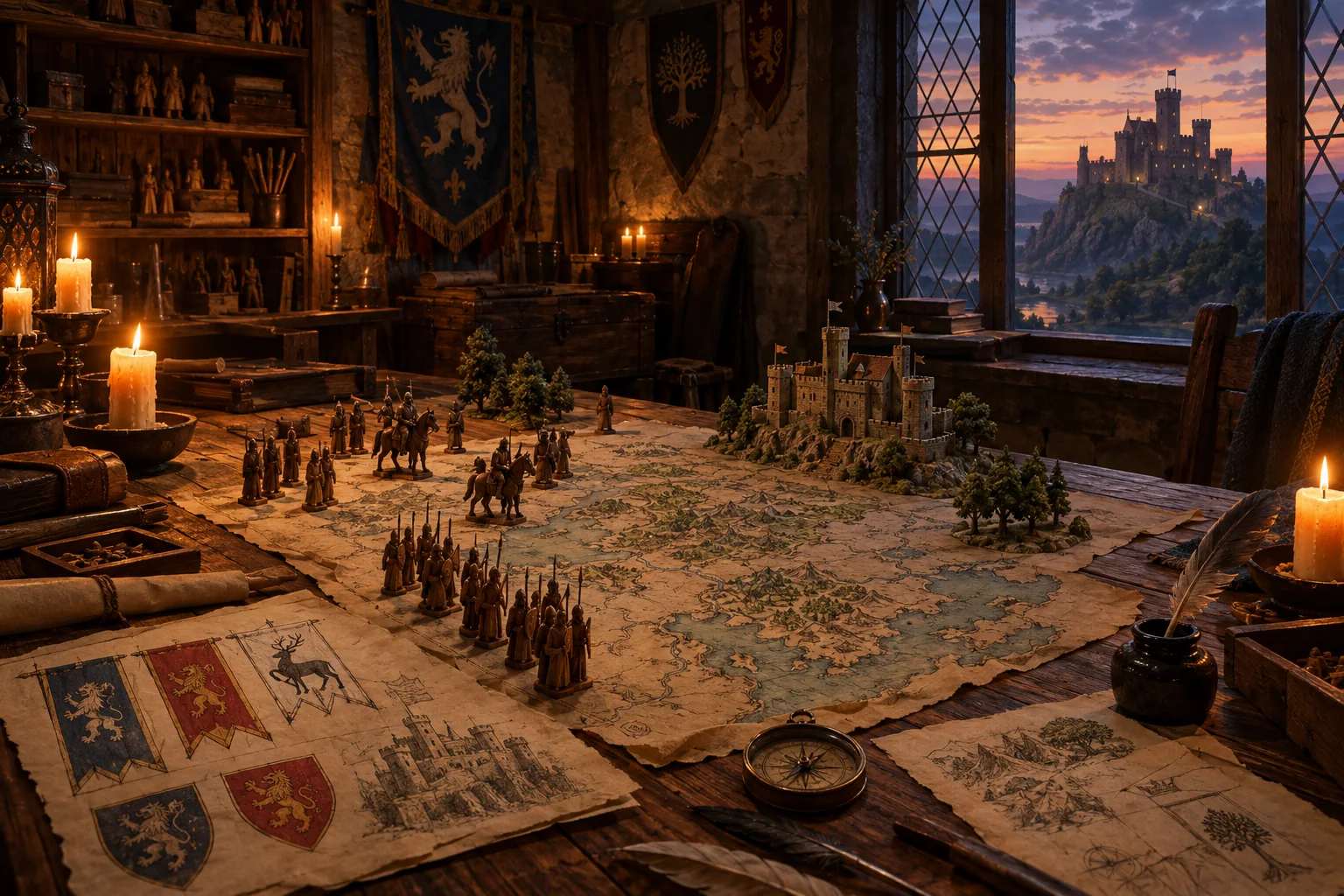
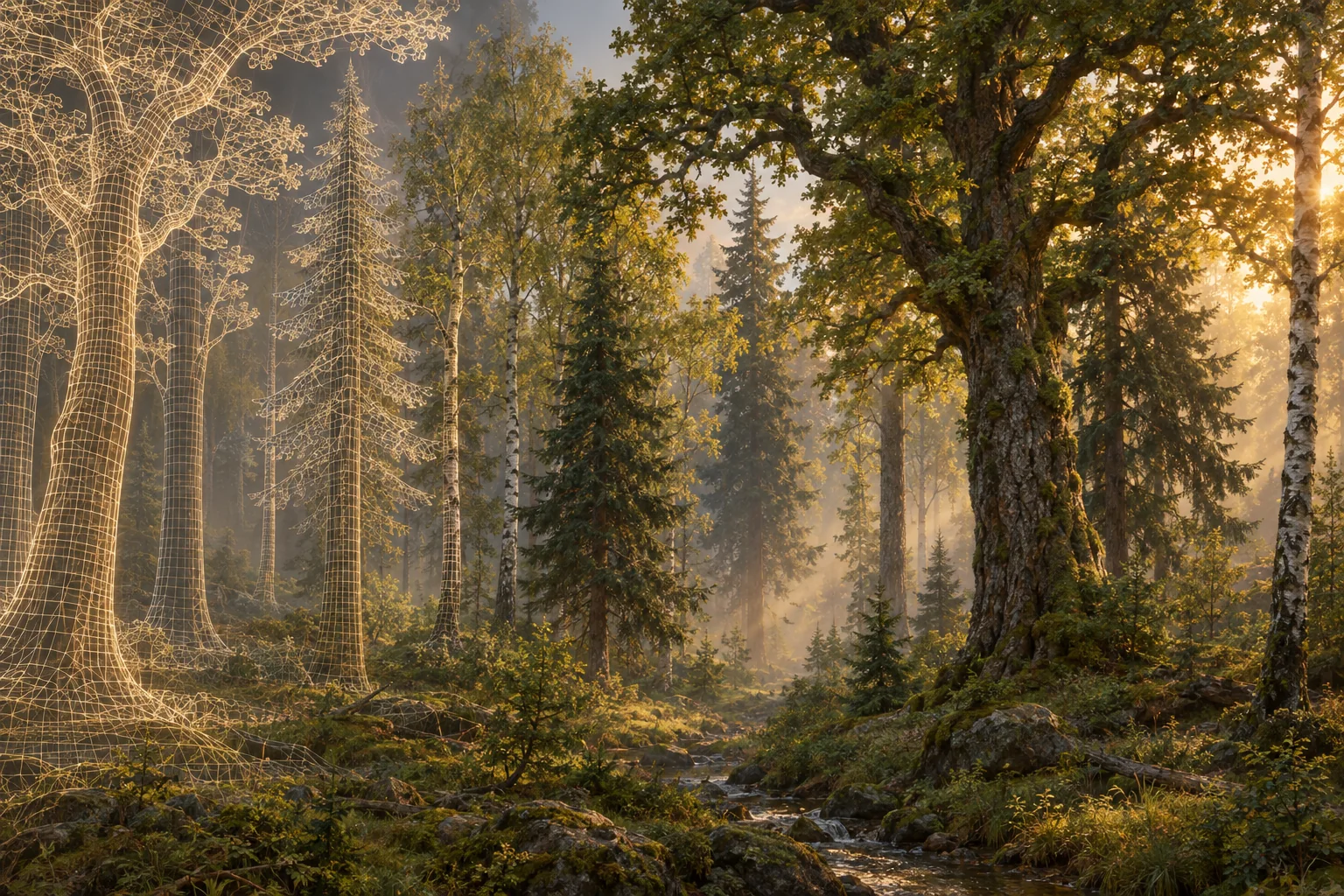
When an army marches through Alardon, thousands of trees stand around it: oaks at the forest edge, spruces on the slopes, birches by the rivers. Each of them has to look good when the camera is close and cost the graphics card almost nothing when it stands on the horizon. No artist can model a forest like that by hand, let alone at several levels of detail.
A tool we built for ourselves
We searched for a ready-made solution for a long time and did not find one that fit. So we built our own. That is how FoliMesh was born: the tree generator that grows the forests of Alardon.
It works simply: you describe a tree in plain words, for example "an old spreading oak at the forest edge". The AI picks the parameters, and the procedural core builds a clean mesh from them. The model itself is not drawn by a neural network: an algorithm assembles it, so it is tidy and predictable.
Trees for real games
FoliMesh is made for game budgets, not for pretty renders:
- four levels of detail at once, from LOD0 to LOD3, each with its own triangle budget;
- the tree keeps the same silhouette at every level, so the forest does not "pop" as the camera moves away;
- the same seed always gives the same tree;
- you can pick a realistic style with photo textures or a low-poly one with flat shading and vertex colours;
- wind weights are already baked into the model, so the tree sways right away;
- more than forty species and shapes: trees, palms, bushes and rocks.
A finished tree is exported as GLB and opens in Unity, Unreal Engine, Godot, Blender and web engines. There is MCP support too: an AI agent can grow a whole forest by itself.
Now it is open to everyone
We decided a tool like this is needed by more than just us. FoliMesh runs right in the browser, with no installation, and you can try it for free: folimesh.com. If you are making your own game and need a forest, take a look. And every tree you will see in Alardon grew right there.